
Over the past year, global education founders and investors have started asking a surprising question:
“Is India still worth entering?”
The narrative is confusing.
Some headlines suggest a slowdown after the pandemic. Others highlight massive growth, new regulations, and big-ticket investments returning to the sector.
So which one is true?
Is India’s EdTech boom fading…
or is the real boom just getting started?
The answer is far more interesting than a simple yes or no.
The Truth No One Is Saying: India’s ‘EdTech Boom’ Was Never Just About Apps
The pandemic years (2020–2022) created a wave of consumer EdTech adoption. Parents bought subscriptions, online tutoring exploded, and every app seemed to raise millions in funding.
But that wasn’t the real revolution.
That was a phase, not the future.
The real opportunity emerging now is bigger, deeper, and more sustainable:
- Digital transformation inside India’s 1.47 million schools.
- Teacher professional development at national scale.
- Curriculum innovation aligned with NEP 2020.
- Global-quality learning tools entering every classroom.
This is the shift global companies must pay attention to.
And it’s why 2025–2030 will define India as the future capital of global EdTech innovation.
Why India Is Becoming the “Silicon Valley of Education”
Not in tech startups.
Not in VC funding.
But in something more powerful:
Scale + Demand + Openness to Innovation
India has:
- 260 million+ school students (largest in the world)
- 1.47 million schools (10x the US school count)
- NEP 2020 pushing digital classrooms
- A rapidly growing private school sector
- A booming international school segment (IB + Cambridge)
- Teachers hungry for modern tools and global methods
Added to that an important behaviour shift:
Schools have become innovation-driven decision-makers.
They want tools for:
- SEL (Social Emotional Learning)
- High-quality English learning
- STEM/STEAM
- Coding, robotics, future skills
- Teacher development
- Foundational numeracy and literacy
- Digital reading libraries
- Adaptive learning
- International curriculum exposure
Global brands like Tilli Kids, Mathspace, Klik2learn, Edshed, and ICA (International Curriculum Association) are seeing demand like never before and IME is leading their expansion across India.
But… Let’s Talk About the Other Side
Because yes — some concerns are valid.
Concern 1: “Is India too price-sensitive?”
Yes, India is price-sensitive.
But India is also scale-hungry.
You don’t need 10,000 students paying $50/month.
You need 50,000 students paying $3–$8/month.
And that makes India more profitable in the long run.
Concern 2: “Is the market too competitive?”
Locally, yes.
Globally? No.
There are entire segments where no world-class solution exists in India, such as:
- SEL
- International early literacy
- Early years curriculum
- AI-driven teacher coaching
- High-quality English certification
- Global assessment frameworks
This is where international brands win immediately.
Concern 3: “Will schools adopt new EdTech tools?”
Here’s the shocker:
Indian educators are among the fastest adopters of global tools.
They experiment.
They evaluate.
They integrate.
They give clear feedback.
This makes India the perfect testbed, almost like Silicon Valley was for early tech products.
Fast cycles.
Large sample sizes.
Real classroom use cases.
So, Is the Hype Real or Overrated?
It’s both depending on how you enter.
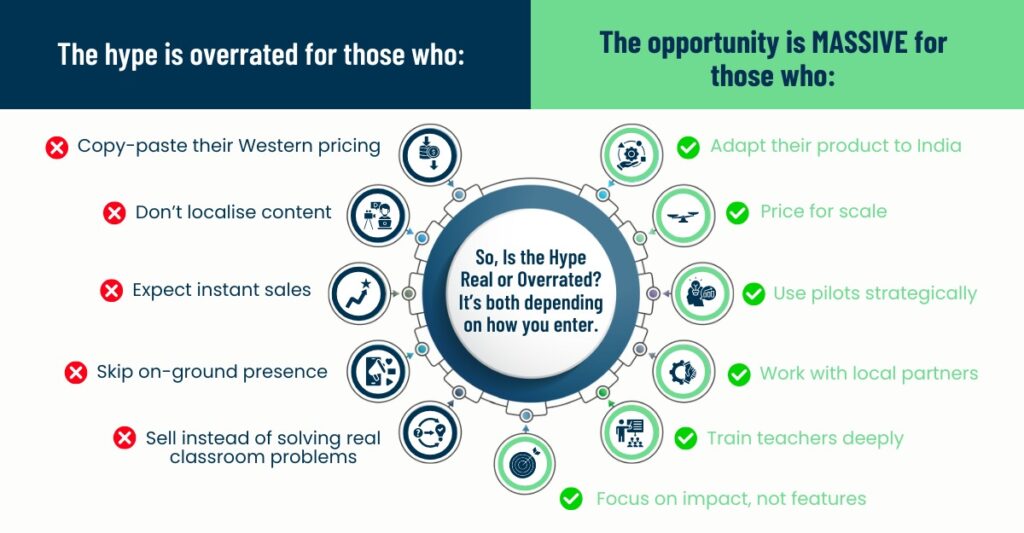
This is exactly where India Market Entry (IME) helps global brands build a sustainable India presence.
India’s EdTech Boom Isn’t Ending, It’s Evolving
2020–2022 was the age of consumer EdTech.
That wave is mostly over.
But 2025–2030?
This will be the age of institutional EdTech where schools, educators, districts, and curriculum leaders drive transformation.
And this ecosystem is just getting warmed up.
Final Verdict: The Real Boom Starts Now.
India isn’t the next Silicon Valley.
India is the Silicon Valley of Education —
where education innovation meets unprecedented scale.
And the companies entering now will define the next decade of global EdTech.